
Discovering New Words
January 20th, 2006by Jude T. Feld
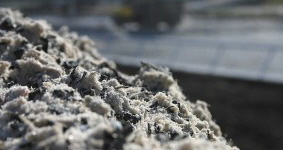
A Mound Of Polytrack Material At Keeneland
The Random House Webster’s College Dictionary prides itself in “capturing new words faster than any other dictionary.” Some of the new additions include the mundane, keypal (an e-mail pen pal); the scientific sounding, nutraceutical (a food that contains ingredients with purported health benefits); the dubious, gaydar (the ability to recognize another person is homosexual) and the queasy, wetware (the human brain when thought of as a computer).
Racing aficionados will also have to come to grips with new words, Polytrack and Cushion Track. The talent at TVG has already embraced the use of the new words and their shortened forms – Poly and Cushion – when referring to workouts and races, so it is imperative that you know what they are talking about.
Revolutionary in its design, Polytrack, developed by Martin Collins, is an entire system, encompassing a specially designed top layer that works in tandem with a unique vertical drainage structure.
The top layer, comprised of silica sand, fibers and recycled materials provides a soft cushion for the horse and rider. It is covered in a wax coating that allows water to flow freely through the top surface to the sub layers below and helps avoid a freezing or inconsistent racetrack, even in inclement weather. The sub layers include porous macadam and dense aggregate rock that provide a solid foundation while vertical drainage pipes carry water away from the track. Together, these elements provide a safer, more consistent racing surface compared to a conventional dirt track.
Statistics show that Polytrack is a safer racing surface for horses and jockeys. Its soft surface is kinder to horses’ joints and legs.
A Polytrack surface remains consistent regardless of weather. Comparatively, with a conventional dirt track, weather, especially rain and cold temperatures that can cause a racetrack to freeze and thaw, can produce dangerous conditions on a racing surface.
Keeneland, partners with Collins in his North American venture, is the third racing facility on the continent to install Polytrack as its main racing surface. Turfway Park, in Florence, Kentucky, installed the surface in August 2005, and Woodbine, in Toronto, Ontario, Canada, installed Polytrack during the summer and is currently racing on the surface. Keeneland installed Polytrack on its training track in 2004.
Since installing Polytrack, Turfway Park has improved safety, increased the number of starters, and greatly decreased the number of cancelled racing dates due to track condition or weather.
Cushion Track is billed as, “The Trainer’s Choice,” and was the choice of Hollywood Park in Inglewood, California. The surface recipe is reminiscent of Polytrack – Synthetic fibers comprising elastic, polyester and polypropylene are carefully graded and mixed with high-performance, multi-washed, silica sand and blended with a special wax coating.
According to their website, Cushion Track Premier waxed synthetic riding surface has been installed at many national and international venues for racing, show jumping, dressage, three-day eventing, polo and training for its natural feel and performance.
The inherent bounce, ability to absorb impact and cohesion come from a root structure which emulates turf. Durable but forgiving man-made fibers maximize economic life and create a quality surface wholly sympathetic with the horse. The added wax product ensures binding and eliminates dust.
There is an old saying, “Folks in the Thoroughbred business can’t even agree whether horseracing is one or two words.” So it goes with synthetic racing surfaces.
One Turfway trainer was overheard at the Keeneland Yearling Sale, “Those California boys are gonna learn to change their style. Wait ’til Baffert works his best Derby horse in 1:03 and he comes the last quarter in :27.”
California-based trainer Bruce Headley, is a vociferous opponent of synthetic surfaces, mandated by the California Horse Racing Board.
“Old Tanforan was the best surface I have ever seen,” he said. “It was sandy loam. In the past, all good surfaces were loam. Then some genius decided to add organic material and that’s when everything got messed up. The organic balls up in a horse’s feet and causes them to land at an unnatural angle. If they went back to sandy loam, which used to just fall out of the hoof, they wouldn’t need anything else.”
Prominent Thoroughbred owners John Amerman and Michael House feel differently.
“Anything that will keep horses sound is a major improvement,” Amerman said. “We know the current racing surfaces leave a lot to be desired. It would certainly help the industry to lengthen a horse’s racing career from a meet or two to several seasons.”
House mirrored Amerman’s opinion.
“Soundness is a huge issue,” he said. “When you pay a lot of money for a horse, you’d like to see ’em run more than just a few times. I’m glad Keeneland is installing Polytrack. It’s proven to be safer and it will be a big boon to shippers. We have gotten beat at very short prices on off tracks at Keeneland in the past. With Polytrack, the surface is always the same. You can ship in with confidence, knowing that you’ll have a fair track.”
Of course, only time will tell, but my wetware tells me that safer surfaces are going to make a world of difference in the quality of horse racing for years to come.

